

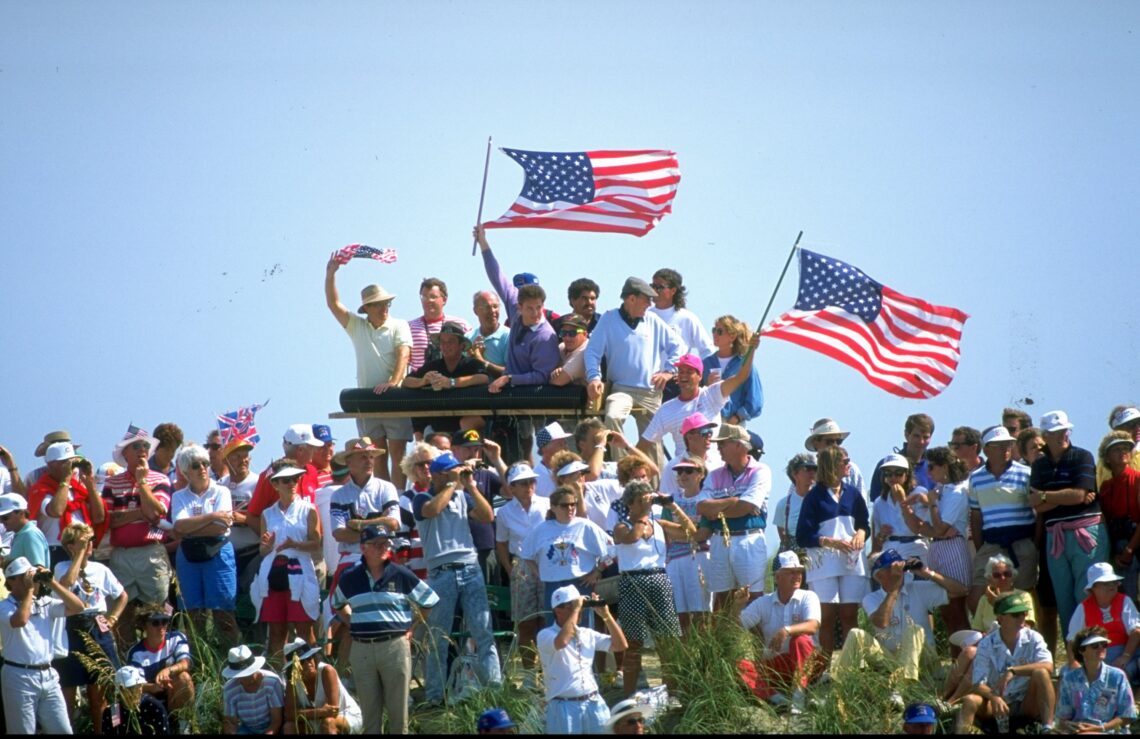


The Ryder Cup took on a completely new atmosphere after Team USA beat the Europeans at Kiawah Island way back in 1991.
Heading into the Ryder Cup 34 years ago, the players on the U.S. team were extremely hungry to win the competition, having lost twice and tied once in the last three meetings.
The rivalry between the Americans and the Europeans had been slowly building throughout the years.
Things started really heating up when Seve Ballesteros began his Ryder Cup career in 1979.
He played on eight Ryder Cup teams in total from 1979 through to 1995, and captained the winning side in 1997 at Valderrama.
The Spaniard brought a level of passion and fighting spirit to the competition that the Americans had not seen from any of the European players before.
So it’s no surprise, then, that Ballesteros was one of the leading protagonists in arguably the most fiercely contested Ryder Cup of all time.
‘War on the Shore’ in 1991 took the Ryder Cup rivalry to a new level
With a moniker like ‘War on the Shore’, the Ryder Cup must have been a feisty one to say the least.
Patriotism was running high in America in September of 1991, with the first Gulf War having recently ended.
And as soon as the European plane touched down on American soil, it felt like the players had landed in hostile territory.
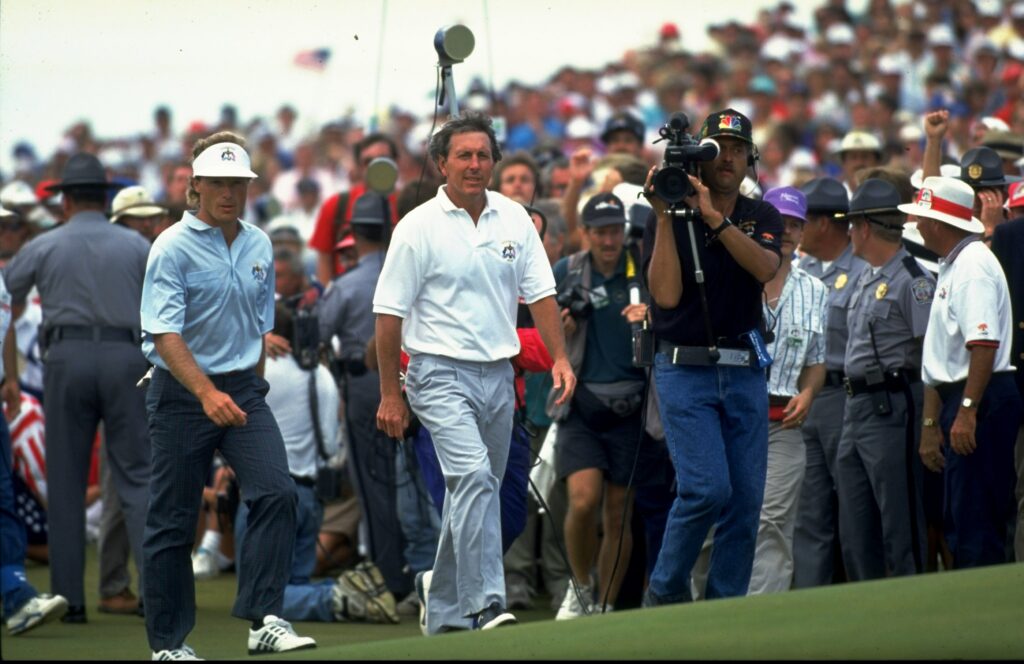
And that’s exactly how it played out.
Team USA arrived on the first day of the competition wearing camouflage caps in salute to the American forces who had returned home after the first Gulf War.
The American galleries were heckling the European players throughout the matches from Friday to Sunday.
Then the needle between the two sides really began. Ballesteros accused Paul Azinger and his partner Chip Beck of changing balls during the pairs matches.
Ballesteros also requested to change a ball that he said was damaged, but Azinger rejected the Spaniard’s claim, and the American got his way in the end.
And later in the week, Raymond Floyd suggested that Ballesteros was purposely coughing during his opponents’ backswings.
Another bone of contention was Steve Pate missing the singles matches through injury, and the Americans being awarded a half point as a result.
You could have cut the tension at Kiawah Island that week with a knife, and the contest remains the most bad-blooded showdown in the history of the Ryder Cup.
Bernard Langer’s missed putt handed the Ryder Cup to the United States
Langer faced Hale Irwin in the 11th game of the Sunday singles.
With the scores sitting at 14-13 to the United States, Langer had a great chance to win his match against Irwin on the 18th hole, tie the overall score and bring the Ryder Cup back to Europe.
The German faced a six-foot par putt on the final hole, after his American counterpart had just tapped in for bogey.
Langer had been going through the putting yips in the buildup to the Ryder Cup, so he probably wasn’t the man the Europeans would have wanted to be in that situation.
The now 67-year-old used a method whereby he placed the shaft of the putter all the way down his left forearm, and then used his right hand to lock the two together at the top of the grip.
It was a putting grip that hardly inspired confidence, but in fairness to him, he did use the method for short putts during his win at the 1985 Masters.
Needless to say though, it wasn’t quite as successful for him on the final hole of the 1991 Ryder Cup as it was at Augusta.
Langer missed the putt and the rest is history. He halved his match with Irwin and the United States ended up winning the contest 14.5-13.5.
It was a crushing blow for Langer at the time, but thankfully, he came through the other side and went on to enjoy an incredibly successful career, including winning another Masters title in 1993.